
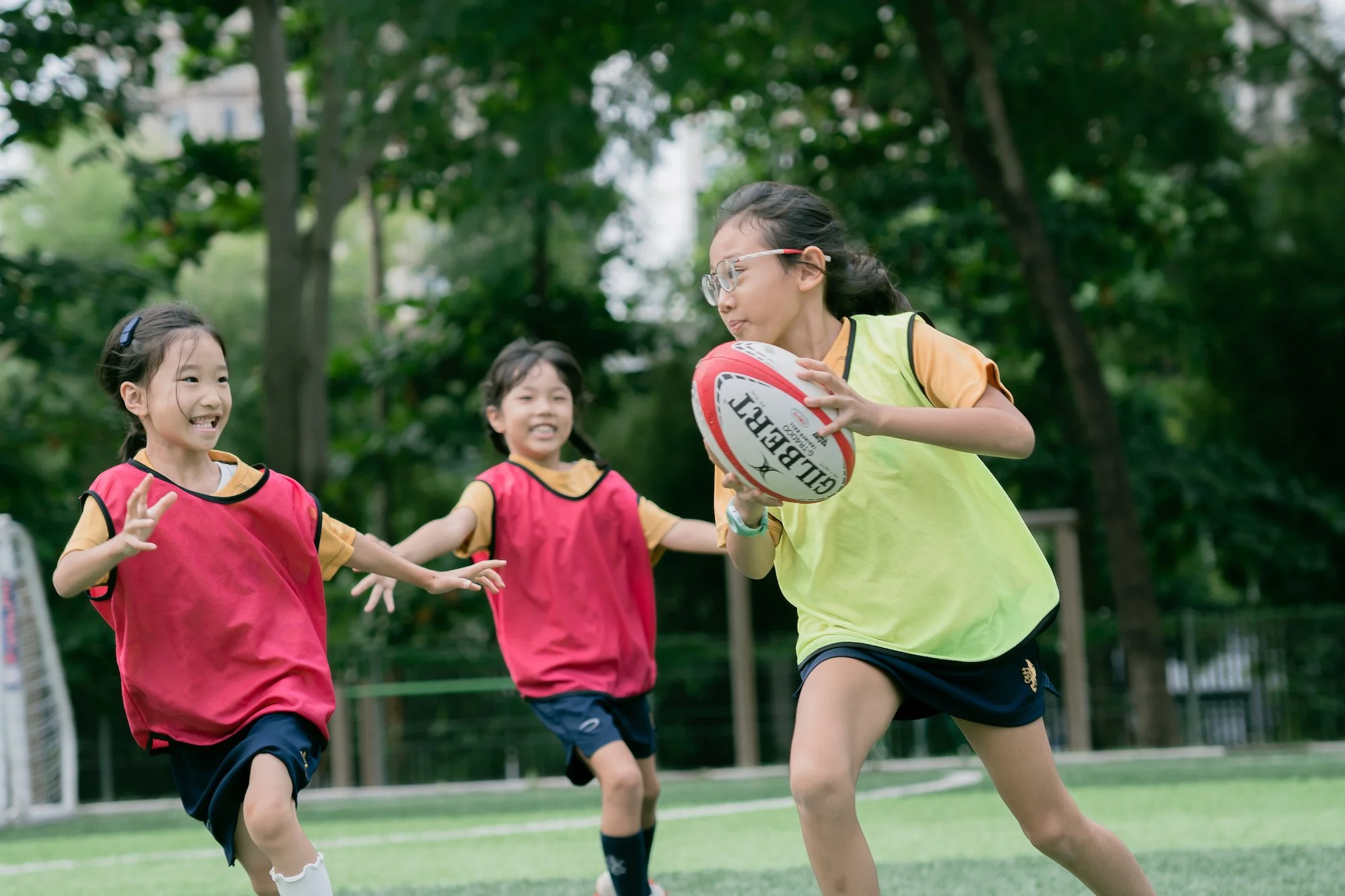
7.3 After-School Activities in Jakarta
What families actually do between 3pm and 6pm, and what it reveals about the way the city works for children. In many capitals, after-school time is a leisurely interlude: the park, a music lesson, a slow walk home. Jakarta behaves differently. It is a city where the heat, traffic, and infrastructure shape how children spend their afternoons just as much as parental preferences or school culture. For families new to the city, the array of after-school options can look overwhelming. But beneath the surface—behind the glossy studio windows, the packed swimming lanes, and the quiet tutoring rooms—lies a pattern that helps explain how internationally minded families organise their daily lives.
"Structured activity early in the afternoon, followed by decompression and home time when roads ease, is the pattern that tends to work."
This article looks at the ecosystem of after-school activities in South Jakarta, where the majority of international schools in Jakarta cluster. It also examines how schools themselves—British-curriculum schools especially—structure after-school provision to balance academic enrichment, sport, and wellbeing.
Why after-school hours matter in Jakarta
The afternoon window carries particular weight in Jakarta because it acts as a pressure-release valve for a day shaped by early starts and dense schedules. Unlike many regional cities where children walk home at 3pm, Jakarta offers no such simplicity. Families must plan around heat, roads, and the limited walkable public spaces.
What emerges for most families is a realistic division of the 3pm–6pm block: a first slot for structured activity (sport, music, language), a second for academic consolidation (homework, tutoring, or quiet reading), and, for many, a final hour spent indoors while traffic subsides. This rhythm is not imposed; it evolves from experience. Parents quickly discover that an unstructured late afternoon often produces overtired children and stressful evenings. Structured activity early in the afternoon, followed by decompression and home time when roads ease, is the pattern that tends to work.
The shape of the after-school landscape
South Jakarta’s after-school ecosystem has grown quickly alongside international schools. The concentration of families in Pondok Indah, Cipete, Cilandak, and Kemang has created a market that is unusually dense for a single district. What distinguishes Jakarta is not the range of activities—most global cities can offer piano lessons and football coaching—but the way these activities cluster inside purpose-built indoor spaces.
Sport and physical development remain the backbone. Jakarta’s climate pushes many sports indoors or into shaded complexes, so swimming, football, badminton, gymnastics, and dance are usually run as structured coaching sessions in pools, halls, and covered pitches rather than casual, drop-in games. Swimming lanes at local clubs fill up between 3pm and 5pm; football and multi-sport programmes use artificial turf and indoor gyms to keep training predictable despite heat and rain.
"If families are navigating unpredictable roads, the most predictable activity should take place where the children already are."
Creative and performing arts occupy another large slice of the landscape. Drama studios in Kemang, dance schools in Cipete and Ampera, and visual-arts workshops around Cilandak offer theatre, ballet, K-Pop dance, band, and fine-arts programmes. They cater to highly mobile communities: children who may stay in Jakarta for only a few years but need continuity of arts education.
Academic enrichment is the third pillar. Some of this happens in external tutoring centres; increasingly, though, British-style schools build reading clubs, maths extension sessions, coding and robotics, enterprise clubs, debating, and Model United Nations into their own co-curricular programmes. For primary-age children in particular, these in-school options usually make more sense than additional travel to separate centres. The picture that emerges is a city where children’s afternoons rely on infrastructure that is intentional rather than incidental.
The role of international schools
It is no coincidence that international schools in Jakarta invest heavily in after-school programmes. In British-curriculum schools—ISJ included—the co-curricular framework is considered part of the school day rather than an optional add-on. The logic is simple: if families are navigating unpredictable roads, the most predictable activity should take place where the children already are.
At ISJ, this approach is organised under the Talent Trails framework, a whole-school system that groups clubs into five strands: Active, Creative, STEM & Strategy, Communication & Culture, and Explore & Adventure. Each club sits within one of these “trails”, and pupils work towards Talent Trails awards over the academic year by sampling a range of strands rather than repeating the same activity term after term. The aim is breadth without chaos: children can try different experiences while families still keep to a manageable weekly pattern.
Clubs run across the week for different age groups, with younger pupils typically joining 2–3pm sessions and older pupils staying for 3–4pm activities. The programme ranges from gymnastics, swimming and football to cooking, cross-stitch, Green Paws gardening, Active Maths, coding, enterprise, debating and oracy, Indonesian culture and dance, botany, zoology, K-Pop dance, badminton, bouldering, and Scottish country dancing.
Enrolment is handled centrally through the school’s information system in two rounds: parents first select core choices, then have the chance to add further clubs if space allows. Clubs run by ISJ staff are classed as co-curricular and are free of charge; those delivered by external specialists, such as dance schools, climbing providers, or coding academies, are treated as extended co-curricular activities with a termly fee added to the school account.
For families who need longer coverage, ISJ operates Twilight Club, a wraparound-care service on campus from 2pm to 4pm Monday to Thursday (to 3pm on Fridays). Twilight is run by school staff, offers light activities and prep time, and is billed hourly, giving parents a structured alternative to sitting in traffic with younger siblings.
This sort of integrated programme means many children can complete their main activity, homework, and some free play before they leave the campus. Evenings at home become quieter, with less pressure to rush across town for yet another lesson.
Micro-geography: why location shapes possibility
Jakarta’s after-school choices are not purely a matter of preference; they are partly dictated by geography. Pondok Indah benefits from large indoor sports complexes and relatively stable roads, allowing families to reach activities without crossing major choke points. Cipete and Cilandak offer a denser network of smaller studios—ballet, pottery, robotics—tucked into residential streets. Kemang is the hub for creative arts, language studios, climbing gyms and early-years-friendly workshops, but its narrow roads require strict timing to avoid bottlenecks.
For families living outside these neighbourhoods, the calculation becomes more constrained. A 3pm lesson in Kemang is reasonable for families already nearby but impractical for commuters crossing Antasari from the west or north. Traffic patterns, not catalogues of offerings, determine what is realistically possible.
This geographical constraint makes on-campus provision particularly valuable. If the strongest programmes come from the school itself, families gain access to high-quality activities without daily negotiations with the city.
The social dimension
After-school hours are also the social spine of school life. Children in international schools tend to form friendships across year levels more easily through clubs and teams than through classroom time alone. In a mobile expatriate environment, these connections matter.
Parents also rely on after-school routines to build their own networks. Swim-practice sidelines, shared transport rotations, waiting in the school café—these become community-building spaces in a city where spontaneous social interaction is limited by climate and distance. Schools with structured after-school programmes effectively create predictable meeting points that stabilise family life.
How families balance activity and rest
Expatriate parents often begin with enthusiasm: football twice a week, music lessons, swimming, Mandarin, gymnastics. Within a term, most refine this to something more sustainable. The optimal load in Jakarta is typically fewer activities than in Singapore or Hong Kong, but pursued with greater consistency. The limiting factor is not ambition but friction.
The children who thrive tend to have programmes built around one anchor activity (sport, music, or art), one slot of academic reinforcement each week, and visible space in the routine for rest. In schools using frameworks such as Talent Trails, awards for breadth can be helpful—but only when breadth is built over the year, not crammed into a single term.
Jakarta’s climate makes downtime non-negotiable. Even indoor activities require travel, and every movement across the city drains energy. Families who bake in margin—time to decompress, hydrate, read, and unwind—report calmer evenings and better mornings.
Why after-school life shapes school choice
For families comparing international schools, the after-school ecosystem offers a revealing lens. Schools that invest heavily in co-curricular breadth often produce calmer, more balanced family routines. Schools with limited on-campus provision inadvertently push parents into cross-city commutes that are rarely sustainable.
A British-curriculum school with strong enrichment—sport, arts, academic societies and structured wraparound care—essentially allows a child’s day to unfold in one location. This is both academically coherent and operationally sensible. It also reflects the structure of high-performing British prep schools, where after-school time is woven into the rhythm of learning and character development rather than treated as discretionary. In Jakarta, this integrated approach is not simply desirable; it is a pragmatic response to the city itself.
About the author
Vivienne, PGCE, QTS, BA (Hons)
Vivienne is Deputy Head (Pastoral) at ISJ, leading safeguarding, wellbeing and the full enrichment programme. She shapes a culture founded on trust, respect and responsibility, ensuring pupils feel safe, supported and ready to learn. Her approach blends pastoral acuity with high academic expectations, promoting holistic growth across the school community.
FAQ
What is the most practical way to manage after-school time in Jakarta?
A structured activity early in the afternoon, followed by homework or calm time while traffic eases.
School Commutes and Traffic: Practical Advice.
Which neighbourhoods offer the widest range of after-school options?
Pondok Indah for sport, Kemang for arts and climbing, and Cipete–Cilandak for a dense mix of smaller studios.
Family-Friendly Neighbourhoods in South Jakarta.
Does the school’s own programme matter more than external activities?
For most families, yes. Strong on-campus programmes, such as ISJ’s Talent Trails clubs and Twilight wraparound care, reduce travel and provide higher consistency than a patchwork of external providers.
How to Evaluate an International School.
Are academic clubs necessary in primary school?
Not necessary, but valuable. Reading groups, STEM clubs, coding, debating and structured study improve readiness without the pressure of extra tutoring centres and additional journeys.
What Makes a Strong Primary School.
How many after-school activities are realistic in Jakarta?
Fewer than in more walkable cities. One anchor activity, light academic consolidation, and protected downtime tend to work best.
Choosing an Early Years Programme.
How do after-school routines support older pupils?
They shape study habits, provide leadership opportunities, and reduce evening homework loads, especially when clubs and supervised prep take place on campus.